What is Advaita?
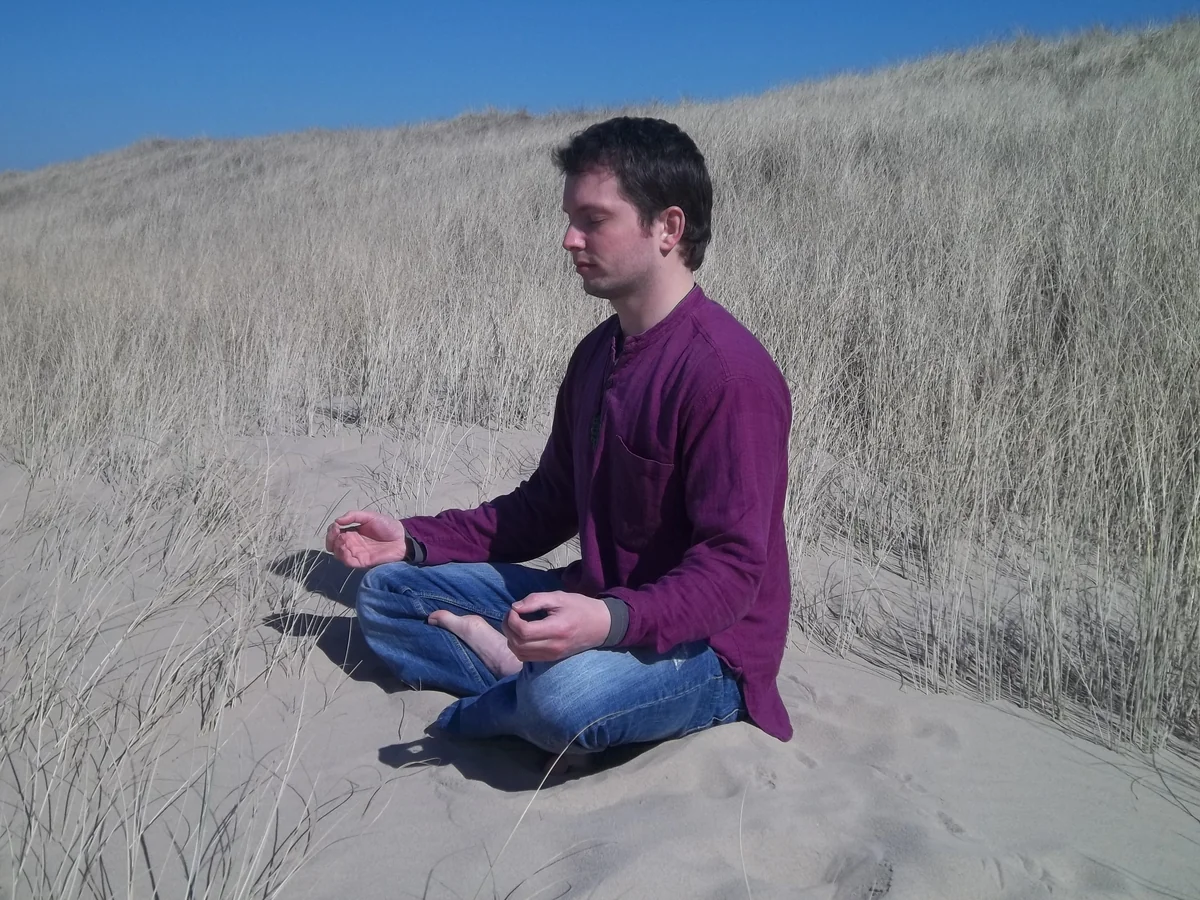
Meditation on the beach (2011)
The attentive reader may already have noticed. Advaita is not Chinese wisdom! It comes from India. But truth rarely respects national borders. And what Advaita describes touches the same core as the I-Ching and Qigong. That is why it has its own place here. All the more so because it contains something essential that is sometimes overlooked in other traditions.
Advaita (अद्वैत) is a Sanskrit word. It literally means ‘not two’. In the West it is also called non-dualism. No separation between you and the world. No distance between the observer and what is observed.
Its origins lie in the Vedanta tradition, one of the oldest schools of philosophy in India. The best-known line of teachers runs from Gaudapada through Shankara (8th century) to modern teachers such as Ramana Maharshi and Nisargadatta Maharaj. What connects them is not a doctrine, but a recognition: what you truly are is not the story you tell about yourself.
At its core, Advaita revolves around one question: what remains when you take away everything that comes and goes? Thoughts come and go. Feelings come and go. Even the sense of being a person keeps shifting. But there is something that does not move along with it. Not as a concept. Not as a belief. But as direct experience. That unchanging something, that is what you really are.
Advaita is not an exercise and not a method. It asks nothing of you. It adds nothing. It simply points to what is already there when you stop searching.
How I experience Advaita
Let me begin with a stubborn misunderstanding. It goes something like this: if there is no doer, it no longer matters what you do. We are all one anyway. So you can’t really harm anyone. Everything is already fine as it is. Just sit back and relax.
It sounds like freedom. But if you look closely, you see something else. This is not a recognition; it is a conclusion. And conclusions are drawn by exactly the thing you are trying to see through in Advaita. The ego picks up the insight and turns it into a licence. “There is no I, so I no longer have to take responsibility for anything.” Do you hear it? There is still someone there who wants something, someone who wants to avoid responsibility.
It is precisely when the personal falls away that something else appears. Not indifference, but a more direct involvement. When the identification with yourself as a person falls away, you begin to see that you have always looked at the world through a narrow tube. Everything filtered through what it means to you, what you think of it, what you get out of it. When the person falls away, that tube falls away too. And what remains is a far wider view. Without the filter of ‘what’s in it for me’, there is no longer a buffer between you and what happens. Pain is pain. Injustice is injustice. Not because you judge it that way, but because you can no longer look away from it.
That may be the most surprising part.
Without a doer, care does not disappear.
The calculation does.
Sometimes something suddenly shifts without you knowing exactly why. Not in what you do, but in who you are. As if life briefly shows itself without you (as a person) standing in between. A shift like that happened to me at a few moments in my life. Not as an experience to hold on to, but as a reminder of something I had forgotten.
To return there, it is often summed up in a single question for self-inquiry: Who am I?
But this is not a question to think about. Not a mantra to repeat a thousand times, nor a search for a rational answer so that your ego or mind finally gets it. It is an invitation to look at where everything appears. Thoughts, feelings, the experience of ‘I’. When you investigate that, something simple can become visible: that this ‘I’ also appears and disappears again.
What remains is nothing special. No constant peace. No perfect state. Just life, but without everything always having to add up for a person. And yes, there are experiences too, of stillness, of peace, but they also come and go, like waves on the ocean.
For me, Advaita is not separate from Qigong or the I-Ching. They are not systems side by side, but different ways into the same shift. Sometimes through movement. Sometimes through insight. Sometimes simply by pausing for a moment.
What can become visible is that life simply unfolds. Not according to your plan. Not in spite of your plan. It simply unfolds. And you can go with that flow. You can also swim against it. That freedom is always there. Only at some point you notice that swimming against the current is mostly exhausting. Not wrong. Just exhausting.
I write more about this in my book Beyond the Practice.