What is Qigong?
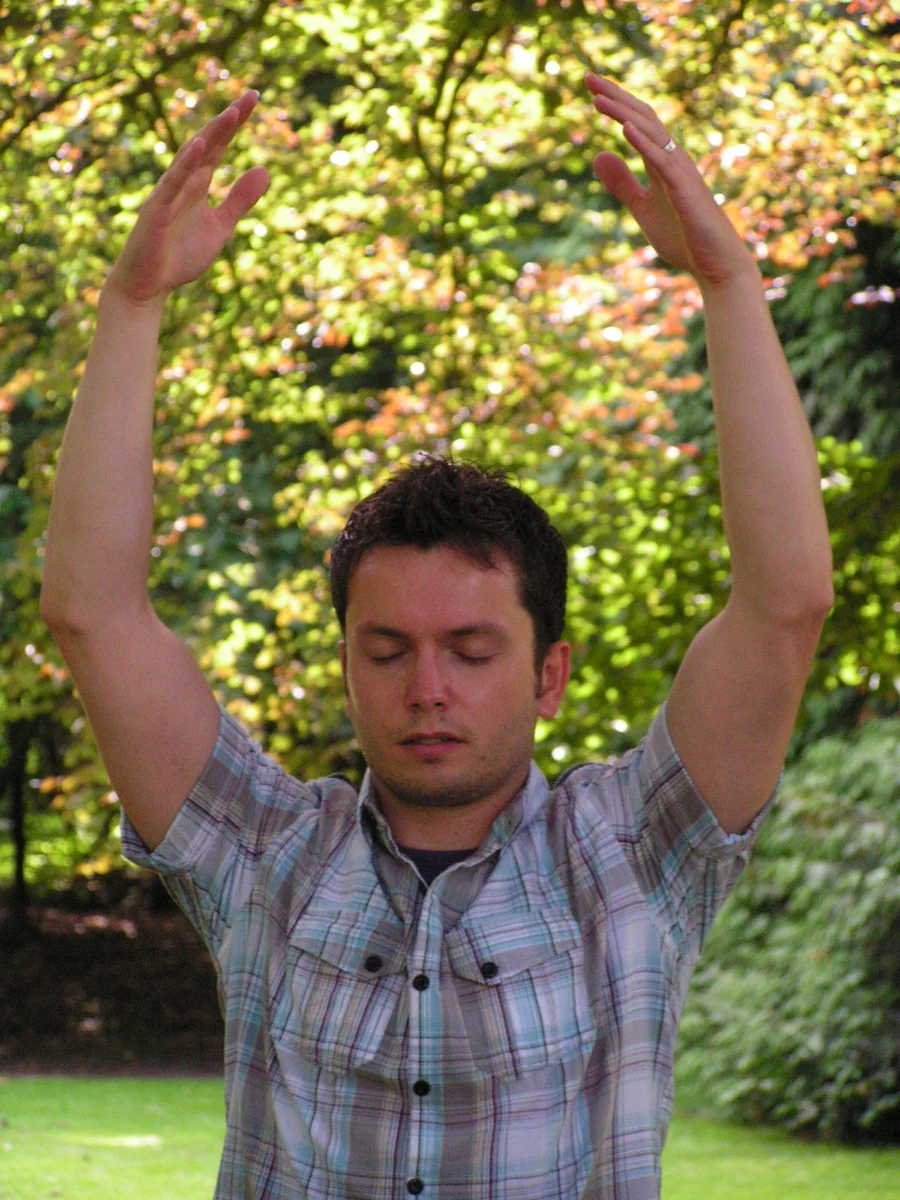
Qigong in Sonsbeek Park, Arnhem (2009)
Qìgōng (气功) is an ancient Chinese practice of movement. The name says it all. Qì means life energy, breath, vitality. Gōng means work, practice, skill. Together: working with life energy.
In practice, Qigong consists of gentle movements, breathwork and focused attention. The exercises are accessible. You need no experience and no particular level of fitness. You start where you are.
Zhineng Qigong is a specific form, developed by Páng Míng (庞明) in the 1980s. The word zhìnéng (智能) means wisdom and ability. This form combines traditional Qigong principles with insights from modern medicine and science. The exercises are clearly structured and easy to learn. In China, Zhineng Qigong is one of the most widely practised forms.
The core is simple. By relaxing the body, letting the breath flow and turning your attention inward, space opens up. Space in which the body can regulate itself. Not by adding something, but by getting in its way less.
How I experience Qigong
There are moments when you notice that your body knows something your mind does not yet understand. Not as a thought. More as a sense of direction. That is how it began for me. Not because I was looking for something to make me better, but because I had a deep knowing that there was a world to discover that I did not yet know.
“Qigong is not a technique,
but a way of listening.”
At first it seems simple. Movements, postures, attention. But the longer you stay with it, the less it is about the form. The movement becomes softer. The effort falls away. And somewhere along the way you notice that there is less of ‘someone’ doing it.
There are moments when there is only movement. Or only standing still. Not directed or thought out, but exactly as it happens. What the tradition calls Qi can be seen as energy, movement, information, life itself. Not something you have to create, but something that moves through you and becomes visible when you interfere less.
At its root, Qigong is not about control but about regulation. When the body relaxes, thinking changes. When thinking falls silent, the body changes. Not because they influence each other, but because they were never separate.
For me, Qigong is not a goal in itself, but a way in.
A way of experiencing what happens when everything becomes simpler.
And sometimes, in that simplicity, what was always there becomes visible.
I write more about this in my book Beyond the Practice.